Make It All Make Sense!

A sermon preached at First Church UCC, Middletown CT on December 19, 2021

Luke 1:39–45 (46–55)

39 In those days Mary set out and went with haste to a Judean town in the hill country, 40 where she entered the house of Zechariah and greeted Elizabeth. 41 When Elizabeth heard Mary’s greeting, the child leaped in her womb. And Elizabeth was filled with the Holy Spirit 42 and exclaimed with a loud cry, “Blessed are you among women, and blessed is the fruit of your womb. 43 And why has this happened to me, that the mother of my Lord comes to me? 44 For as soon as I heard the sound of your greeting, the child in my womb leaped for joy. 45 And blessed is she who believed that there would be a fulfillment of what was spoken to her by the Lord.” 

Back in the dark ages of time, before I went to seminary, I occasionally ate dinner with friends.  One time, her parents were there visiting, and after dinner, we were invited to play cards.  It was a new game to me, and I wasn’t sure about it but we started and we were having a great time – I was doing well, and thought I was winning – but then my friend’s dad said, no you can’t play that card… and the rules turned upside down.  So I followed the new rule, and began to get ahead – and then the rules changed again.  Thoughout the game, the rules changed erratically, and always in favor of my friend’s dad. I never did feel as though I understood what we were doing.  I lost, of course.

It was, in my mind, utter chaos.  I still don’t know if the rules were that complicated, I was that slow in picking them up or the dad was cheating.  I’ve never played it again.  But the chaos of that game was utterly disorienting, and took the fun out of the evening.

You know what I mean? 

Just as we think we know the rules, just as soon as we begin to get our balance again, it seems as though something changes with COVID and we’re turned topsy-turvy, what seemed so sure, even safe, no longer sure… and right around Christmas, too… a time when we count on doing what we’ve always done, a time when the stability of the usual means so much, and it seems so broken.

I think that this year, this COVID, has thrown us right back to something about our faith that we don’t often see.  It’s thrown us back to a truth we’d rather hide.  Chaos is part and parcel of our world.  

Chaos is part and parcel of our reality.  We try to hide the chaos, we’re frustrated and embarrassed when it shows up, but it is there.  Much of the time we try to control that chaos – we make laws, we have customs and habits – and hopes and dreams – but chaos is always right out there on the edge of life.  And this year, it’s closer than ever.

That’s bad.  But it’s also good, in a weird way.  It’s good because it helps us see more clearly than in decades just what good it is that faith brings to us.

Into a world with its own version of cataclysmic chaos came a baby.  Jesus didn’t magically “make it all right,” as much as we might wish that were so.  What he did, and continues to do today, is that he helps us see and live out a way which takes the energy of chaos and helps us use it to form lives of meaning and purpose.

Mary touched chaos with the visitation of the angel, and her immediate thought was to go see her cousin Elizabeth, who had likewise been touched.  The two pregnant women, pregnant under the strangest of circumstances, embraced and in their conversation found a way out of chaos.  Mary proclaims that way in the words known as the Magnificat:

“My soul magnifies the Lord,
and my spirit rejoices in God my Savior, 
 for he has looked with favor on the lowliness of his servant. 
Surely, from now on all generations will call me blessed; 
for the Mighty One has done great things for me, 
and holy is his name. 
His mercy is for those who fear him 
from generation to generation. 
He has shown strength with his arm; 
he has scattered the proud in the thoughts of their hearts. 
He has brought down the powerful from their thrones,
and lifted up the lowly; 
he has filled the hungry with good things,
and sent the rich away empty. 
He has helped his servant Israel, 
in remembrance of his mercy,
according to the promise he made to our ancestors, 
to Abraham and to his descendants forever.” 

Those words are a declaration that in the midst of a random world, there is justice.  In the midst of an uncaring world, there is love.  In the midst of everything that can go wrong, there is still meaning and purpose to our lives.

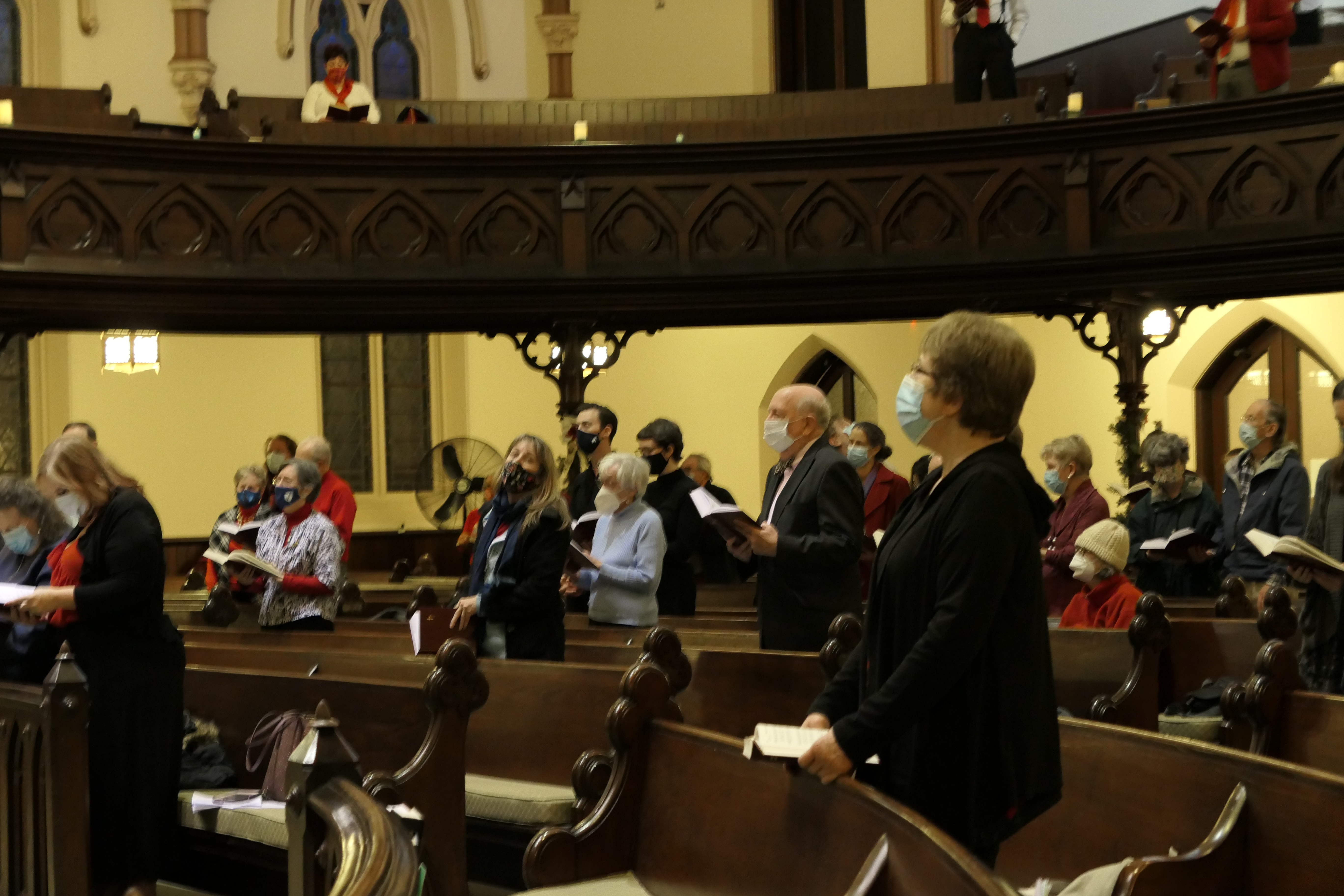
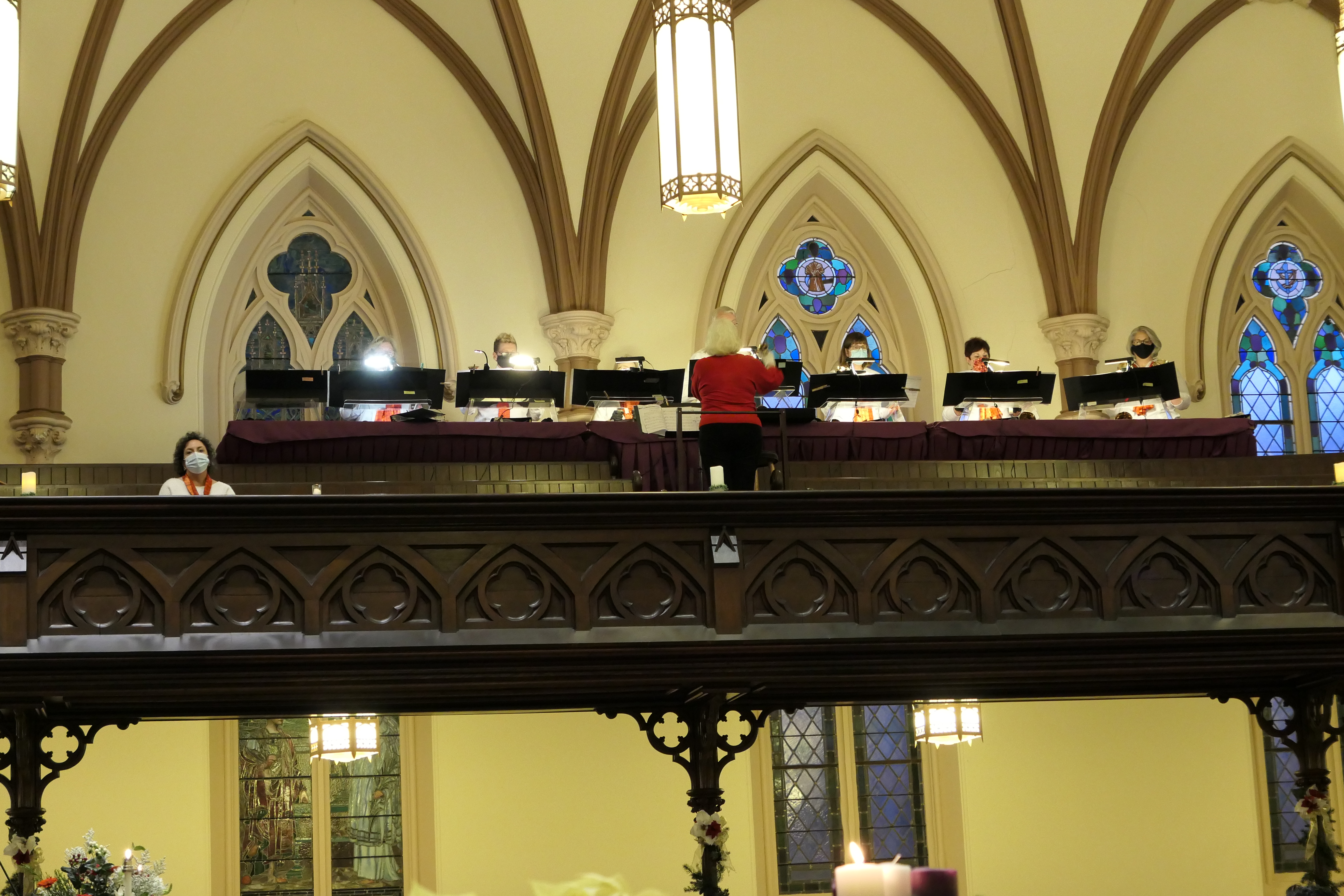
We are made to live out God’s spirit.  The true counter to chaos is not a new and better COVID protocol, as much as I’d love to see that.  It’s not even a perfect vaccination, and everyone in the world signing right up, as much as we’d all like to see that.  The true counter to chaos is a Christmas dinner, open to all, served to anyone, welcoming the poor and the rich.  The true counter to chaos is a bell choir, started this fall, and already producing music which lifts our hearts.  The true counter to chaos is Heather Kennedy and her many colleagues who care for us when we are ill with a compassion which goes beyond the minimum required.  The true counter to chaos is love.

When I was in seminary, I had a number of classmates who were Presbyterians – there was a friendly rivalry among us… we’d tease them about their need to “go by the book” and they’d give it right back about the truth that we had no book.. we were the Un-tied Church of Christ.  But under that friendly rivalry, was a truth that we can all hold onto.  God has called  us to create order out of chaos, to live (in the old Presbyterian way) decently, and in order.  This is the gift of the babe of Bethlehem…. meaning, purpose, order, justice, mercy and love.

Amen.

permission has been obtained through CCLI for all music.

© 2021, Virginia H. Child

Here Comes the Hard Part

A sermon preached at First Church UCC, Middletown CT on December 12, 2021

Scripture: Luke 3:7-18

John said to the crowds that came out to be baptized by him, “You brood of vipers! Who warned you to flee from the wrath to come? Bear fruits worthy of repentance. Do not begin to say to yourselves, ‘We have Abraham as our ancestor’; for I tell you, God is able from these stones to raise up children to Abraham. Even now the ax is lying at the root of the trees; every tree therefore that does not bear good fruit is cut down and thrown into the fire.” 

And the crowds asked him, “What then should we do?” In reply he said to them, “Whoever has two coats must share with anyone who has none; and whoever has food must do likewise.” Even tax collectors came to be baptized, and they asked him, “Teacher, what should we do?” He said to them, “Collect no more than the amount prescribed for you.” Soldiers also asked him, “And we, what should we do?” He said to them, “Do not extort money from anyone by threats or false accusation, and be satisfied with your wages.” 

As the people were filled with expectation, and all were questioning in their hearts concerning John, whether he might be the Messiah, John answered all of them by saying, “I baptize you with water; but one who is more powerful than I is coming; I am not worthy to untie the thong of his sandals. He will baptize you with the Holy Spirit and fire. His winnowing fork is in his hand, to clear his threshing floor and to gather the wheat into his granary; but the chaff he will burn with unquenchable fire.” 

So, with many other exhortations, he proclaimed the good news to the people. But Herod the ruler, who had been rebuked by him because of Herodias, his brother’s wife, and because of all the evil things that Herod had done, added to them all by shutting up John in prison.

May the words of my mouth and the meditations of our hearts be acceptable in your sight, O God our Rock and our Redeemer.  Amen.

Here we are at the third week of Advent, closer and closer to Christmas, to the birth of Jesus, and instead of a story about Jesus, we get a story about his cousin John, whom some scholars believe was also Jesus’ major rival.

What’s more, this is one of those stories that bigots over the centuries have turned into anti-Semitic propaganda.

What’s up with that?  Why this story?  Why here, and what does this story mean for us today?  

Our reading takes place in a particular place, at a particular time, and it’s helpful to understand that.  The Israelites of that day, lived in an occupied country.  They were used to what that meant; in the Middle East of that time, their land was the main highway between the Egyptians and the Persians, the two main powers of their world.  If you know European history, it’s something like the situation of Alsace and Lorraine in the decades of war between France and Germany, or something like Catalunya or the Basque country in Spain.  In other words, not only did they not have much control over their land, but they were always in danger of just plain disappearing, being assimilated into the dominant culture.

Along with the cultural questions, the religious leaders of the time were expected to help keep the peace in the occupation of the land by the Romans, and the government of the many and various, but equally slimy Herods, not one of whom was worth a red cent.  The poorer you were, the less power you had, the less you trusted the Herods, and the less you thought of the heads of the Temple in Jerusalem, who couldn’t win for losing.  

If they stood up for the am-haaretz, the poor of their country, the Herod of the day, or the Roman governor would smash them down.  

If they supported the Romans, they ran the risk of rebellion.  

Into that context stood John the Baptist, trying to call folks to repentance, naming names, and getting into trouble.    

There’s one level on which this is a story about the conflict between taking care of  yourself and doing the right things.  It’s a story about people who, bereft of effective leaders, begin to take things easy.  It’s a story about the foundations belief in Judaism that right believe is shown by right behavior.  Yes, it’s a story about specific people in a specific time, but it is not just about them, and then.  It is a story which applies to here, and now, and to every time and place where we are tempted to substitute saying the right things to living in the right way.

John says that some folks have been defending their wrong actions by claiming that they don’t have to worry, that they “have Abraham as their ancestor”… to which he responds, “big deal.  God can make descendants for Abraham by the dozen; you didn’t do anything to make that happen.  If you can’t be bothered to live up to Abraham, you won’t last long.”

You know, it’s not about literally being a descendant of Abraham.  It’s about privilege, the thing that these days, we call “white privilege”.  And around here, sure it’s about being white.  But it’s also the privilege of having been born here, having gone to a better school than others, being smarter, having more resources, or any number of other things that give us a step up in the world.  John’s saying that having been given that step up, we now need to live up to it, and help the world around us.

Then he starts telling how – share what you have with those who don’t have enough.  Do your jobs honestly, don’t cheat, don’t over charge.  This isn’t a place for a long list; he’s simply responding to the jobs the people there have, and pointing out how they could do them more faithfully.  

So, what he’s really saying is that, whatever you have – money, power, influence – use it to make things better.  Be honest, be loving, be just, be merciful.  Live out your faith.  Be who you say you are.

He’s saying that we’re no longer bound by the expectations of our world.  Instead, we are freed to live under the commitments of our faith.  We don’t have to stop with what we think is possible; we are freed to think towards what needs to be done.  It’s not about the limits of possibility or practicality; it’s about the call to build on God’s foundations – what does our world need?  How can we get there?

Today in the Christian Calendar, is Joy Sunday.  that started because Advent had been celebrated as a kind of Lent, no meat, no eggs, no fun… and this Sunday was a day off from that denial.  But today, it’s Joy Sunday, because on this day we see the practical meaning of the idea that we are freed from the sin of living within custom and assumption.  Today, we see how Jesus will show us how to strike off the bonds that prevent sharing, block love, make it too easy to think “me and mine first”.

Today is Joy Sunday because today we see the first signs of our freedom coming, a new and better way to live.  And that is the best thing of all about Christmas.

Amen.

© 2021 Virginia H. Child

Permissions to record/share the music have been obtained through CCLI.

The Peace Which Passes Understanding

A sermon preached at First Church UCC, Middletown CT on December 5, 2021

Philippians 1:3-11

I thank my God every time I remember you, constantly praying with joy in every one of my prayers for all of you, because of your sharing in the gospel from the first day until now. I am confident of this, that the one who began a good work among you will bring it to completion by the day of Jesus Christ. It is right for me to think this way about all of you, because you hold me in your heart, for all of you share in God’s grace with me, both in my imprisonment and in the defense and confirmation of the gospel. For God is my witness, how I long for all of you with the compassion of Christ Jesus. And this is my prayer, that your love may overflow more and more with knowledge and full insight to help you to determine what is best, so that in the day of Christ you may be pure and blameless, having produced the harvest of righteousness that comes through Jesus Christ for the glory and praise of God. 

Luke 3:1-6  

In the fifteenth year of the reign of Emperor Tiberius, when Pontius Pilate was governor of Judea, and Herod was ruler of Galilee, and his brother Philip ruler of the region of Ituraea and Trachonitis, and Lysanias ruler of Abilene, during the high priesthood of Annas and Caiaphas, the word of God came to John son of Zechariah in the wilderness. 

He went into all the region around the Jordan, proclaiming a baptism of repentance for the forgiveness of sins, as it is written in the book of the words of the prophet Isaiah, 

“The voice of one crying out in the wilderness: 
‘Prepare the way of the Lord, 
make his paths straight.
Every valley shall be filled, 
and every mountain and hill shall be made low, 
and the crooked shall be made straight, 
and the rough ways made smooth; 
and all flesh shall see the salvation of God.’ ”

May the words of my mouth and the meditations of our hearts be acceptable in your sight, O God, our Rock and our Redeemer.  Amen.

  • In the first year of the presidency of Joe Biden, 
  • when Ned Lamont was governor of Connecticut
  • while Darrell Goodwiin was the Conference Minister of the Southern New England Conference of the United Church of Christ, 
  • the Word of the Lord came to the people of the First Church UCC in Middletown, Connecticut.

Right now.  Right here.  Not in some far off time, yet to be determined.  Not in some imaginary perfect place.  But right here, right now.

Not when the paint’s been done.  Not when the extra weight’s been lost.  Not when the kids become perfect, or the ill are healed, and surely not when Captain Ahab finally catches the whale Moby-Dick.  Right here, right now.

That’s when and where Jesus is.  That’s where the baby will arrive.  That’s where God is, all the time.  Right here, in the midst of everything.  That’s where God is.

If you are looking for God, you need not yearn for some far off place of imagined peace.  God is not only in the stark landscape of, say, rural New Mexico, but here as well.  God is not only in our summer homes, or when we are immersed in work, or hobby, or boating on the Connecticut.

Where we are, God is.   Where God is, there is peace.

Don’t mistake God’s peace for a the quiet of an empty room.  God’s peace isn’t the quiet of nothingness; it’s the peace of worthwhile purpose and meaning.  God’s peace is not the lack of human contact; it’s in the hurly-burly of helping those in need.  God’s peace falls on those who make our world better – the policeman working the early morning shift; the school bus driver on yet another cold morning, the clerk at the big box store who greets every customer.

And don’t confuse the activity of God’s peace for the chaos of ordinary life.  God’s peace is in the midst of life, but it’s not that never-ending pile of laundry, or the never-empty sink of dishes.  

God’s peace is in the midst of the chaos of daily life.  It is found as we pay attention not just to what we’re doing, but how we’re doing it.  

Martin Luther, the great founder of the Reformation, used to say that any work we do, any task we undertake, can be a way of being in God’s presence when we do it intentionally.   

I don’t think he ever said that would be eternally easy.  After all, he and his wife had six children – this in a time when no one had yet invented the stove, refrigerator, or even indoor plumbing.  They kept open house for all Luther’s students, and rented out rooms in their home (a former monastery) to make money.  I think it’s fair to expect that that home was more than a little chaotic.  In the midst of all that, the Luther family nurtured a sense of God’s peace.

Have you seen the on-line Christmas commercial that features a dad dancing with his baby son?  It shows dad dancing for the son in all sorts of places as the son grows up.  At first, it’s just about dad having fun, you know?  And then it seems to mostly be about the kid’s discomfort as he hits the teen years… but then comes the final scene.   A phone is ringing in the dad’s home; he searches for it and finds it in a Christmas present box.  He opens the present and answer the new smart phone – and there is his son, dancing with a newborn grandchild.  

I’m betting that for a long time, that son thought the dancing was all about his father, and maybe even his dad’s attempts to embarrass him… but on the day he first picked up his own child, he realized that the dancing was a way of showing his child the love and joy of life.  It’s all about being clear as to why you’re doing what you do and bringing your why and your what together.

That’s harder than it should be.  It’s harder, not because there’s something wrong with us.  It’s harder because we’re going through a terrible time.  We didn’t expect this, couldn’t plan for it. We’re all stressed; we hoped that COVID would be completely gone by now, and instead we keep getting new variants.  Yes, things are better than last year; but they’re not where we thought they’d be.   We’re still wearing masks.  Life still doesn’t feel safe, reliable…. even at our safest, we’re a little hesitant to go to concerts or gather with the family.  Life is harder than it should be, and that means it’s more wearing.  

It’s easier, these days, to work off our frustration by being snarky.  It feels good to upset people.  One of my favorite cartoons has a story running right now about three eighth-graders… one of whom is always critical of the clothes or hair of the other two.  “Wow,” she says, “that sweater is…ummm…. really bulky, isn’t it?”  or “that hairstyle is very nice, very third grade”…. and the others are totally upset.  That’s what our world feels like these days.

Here’s the thing:  we don’t need to be stuck in that hard place.  We’ll go there, from time to time, but we don’t need to stay there.  We can, with intentionality, re-focus ourselves on each day.   Because God’s good news comes to us, right where we are, right in the midst of our struggle to live in good, kind, and loving ways.  

The peace of God, then, comes to us most clearly when we are trying to live our lives in accordance with God’s way, when we are trying to be people of peace, when we are trying to sustain justice, show mercy, create love, be followers of Jesus Christ in this Advent season.

Amen

© 2021, Virginia H. Child

Some Years, Hope is Thin on the Ground

A sermon preached at First Church UCC, Middletown CT on November 28, 2021

Scripture:  Jeremiah 33:14-16

The days are surely coming, says the Lord, when I will fulfill the promise I made to the house of Israel and the house of Judah. In those days and at that time I will cause a righteous Branch to spring up for David; and he shall execute justice and righteousness in the land. In those days Judah will be saved and Jerusalem will live in safety. And this is the name by which it will be called: “The Lord is our righteousness.” 

we wait for a time when the living is easy

I put my Christmas tree up this week.  Thanksgiving is over and gone and my heart and my hope has turned to the message of Christmas.

Of course, I know, and you know, that it’s not Christmas, not yet.  and what I’m looking forward to really isn’t the part about getting together with family.  Sure, that’s important, and there’s just nothing like getting together with family – if that’s possible.

But that’s not the center of Christmas, not for those of us who follow the Christian path.  That part of the Christmas experience is something that’s only available to some of us.  It is less than nothing for those of us who have no family, or no family that welcomes us.  It is too much struggle for those of us who don’t have the dollars to spend on the gifts our families want. That Christmas, with its dream of a perfect gathering, lots of happy people, everyone enjoying themselves…. for too many of us, it is a dream.  And for all of us, it is a diversion, pulling us away from the deepest joy of Christmas.

Advent is a time to remember just exactly why we started looking forward to Christmas.  

Some years, this season is even harder than usual.  Some years, hope is thin on the ground.  and yet, yet, we remember, that the first thing to know about the path to Christmas is that it begins with hope.

Anne Lamott writes:  “Hope begins in the dark, the stubborn hope that if you just show up and try to do the right thing, the dawn will come. You wait and watch and work: You don’t give up.”  and her words are particularly apt for a season in which things continue to go in the wrong direction.  Her words speak to us, because she’s speaking truth:  hope begins in the dark.

We don’t need hope if we already have everything.  But the idea that we could have everything, and everything right and perfect – that’s one of the big lies of our world.  The truth of our lives is that we’re not perfect, that sometimes we’re really really far from even bare acceptance.  Sometimes the turkey isn’t any good.  Sometimes we spend the day shrinking from yet another political rant.  Sometimes mom dies just before the holidays.  Sometimes.  sometimes.  

And we are left, not with perfection, but with a struggle to even be good, and what keeps us going is hope.

Hope isn’t about what we have, or don’t have, or what happens or doesn’t happen. Last week we were cast down by the news of the Rittenhouse verdict; this week, we have the Arbery verdict to celebrate.  Life is something of a roller-coaster when we build our happiness on the facts of what’s happening.  Hope is a sturdier frame on which to build our lives because it focuses on the long term, keeps us from totally losing it when things take a dive, keeps us from thinking we’ve got it made when everything is going superbly.

Hope is a foundation on which we can build a good life.  That’s because hope doesn’t require success in order to be good, effective, life-changing.  It only requires our readiness to try again, to hope to make it better, to be ready to recognize that most of the time, what makes our lives good is sometimes little.

Our ancestors in faith heard God’s constant promises of hope throughout the stories of their faith.  In Jeremiah, God promises that there will be a better leader, a righteous branch, who will come to save them. Back in those days, it’s most likely that they saw the coming of a new king, a leader, who would drive out all those who sought to conquer their land.  In these days, we read that a little differently, and see a promise that there will be someone whom we can follow, who will give our lives a meaning that will endure through all the bad times.

We are waiting, then, for the coming promise of a better world.  

We are hoping, in our waiting, for a world where God’s promised justice rules actions, where God’s promised mercy lightens hearts, where God’s promised love brings strength in the midst of stress.

We are hoping, in our waiting, for Jesus to show us, once again, how to live.

Amen.

© 2021, Virginia H. Child

Permissions to record/share the music have been obtained through CCLI

Thank God for Mercy

A sermon preached at First Church UCC, Middletown CT on November 21, 2021

Deuteronomy 5:6-11 I am the Lord your God. . .

Luke 10: 25-37 …what must I do to inherit eternal life?

Well, I was all set to share with you some thoughts about tradition and Thanksgiving, giving thanks and recognizing mercy…. right up to Friday afternoon, when the verdict came out on the Kyle Rittenhouse case, and my Facebook feed exploded with outrage.

If I’d had any doubt about the political leanings of my friends, they were cleared up rapidly.  The pain, the anger, the frustration were pretty much overwhelming.

There’s a lot that could be said about the Rittenhouse case – and over the next few days, a lot will be said and written.  We might meditate on the firearms laws in Illinois which allowed a teen-ager to purchase such a weapon.  We might critique the laws of Wisconsin which have such an expansive view of self-defense.  We could complain that the laws which protected Kyle Rittenhouse did not protect the people he killed.  We could meditate on the differences which mean that abused women rarely find self-defense a defense or which mean that a Black person carrying a rifle into a demonstration would likely not survive to the trial.  

We might wonder where God is in all this.  We might wonder what mercy means.

We might wonder what mercy means to us, to God, to those who’ve been hurt and want recompense.  

What is mercy?  What does it mean to be merciful?  And, today, is mercy a free pass to do it again?

The words we read together from our Pilgrim Hymnal, the words we know as the Ten Commandments, outline for us an ethic for living, are a set of guidelines for our lives.  They look really simple, don’t they?

Don’t have any other gods before me.  Sure, ok.

Don’t swear on God’s name.  Yeah.

Observe a sabbath.  Hmm…. but when will I do this, or that?

Honor our parents. Don’t commit adultery.  Don’t steal.  Don’t lie.  Don’t covet.. Don’t try to take what belongs to others.

They look easy.  But they’re not.  We put our work before our God.  We put keeping things simple before our God.  We act like we’re in charge, not God.  We work too hard, we lie, we steal, we cheat on our spouses…  That’s the reality of life.

And being holier than everyone else isn’t going to keep us from stepping out on the wrong path, or refusing to take the right one.  That’s what Jesus’ story about the good Samaritan is really about.  Being a good person, having a job of high responsibility doesn’t mean that all  your decisions will be good ones.

Our world is filled with justice, with the administration of laws, but justice without mercy is nothing but a little bookkeeping, and these days, perhaps the kind of imaginative bookkeeping which can cause you to be a guest of the state for a number of years. 

We can’t fix what we think is wrong with the laws in Wisconsin, and we can’t change the verdict in the Rittenhouse case.  So, let’s think about what we can do, and can do right here.  You’ll know the problems on the ground much more clearly than I do, but here’s a couple.  

We can continue to work to tighten up the ways firearms can be purchased and used in this state, in this city.  I was horrified – a couple of interims ago – to discover I had two parishioners, each in the early stages of dementia, who owned and used firearms.  One of them had a Massachusetts concealed carry license, and we discovered he always wore a gun to church.  This led to productive conversations, first, about how to deal with gun owners as they developed impairments, and secondly, did we want to have a rule about guns in our church.  The rules say, don’t kill…. so what can we do to make it less likely that someone will do so?

We can continue to speak out about abuse.  One of the memes I kept seeing over and over yesterday said something like, “thousands of women who used self-defense as their defense in their murder trials would like to be treated like Kyle Rittenhouse”.  What are we doing about domestic abuse?  How do we support those who live in fear for their lives?  

These are not the only things we can work on; and working on them would not take anything away from our commitment to be involved in racial justice issues, because each of them is steeped in the pervasive stink of prejudice.  

Mercy, if it is to be an active word and not just a passive feeling, is so not about Kyle Rittenhouse.  It is about us.  It is about how we interact with the rough places in our world.  My guidance would be different if I were the pastor in Kenosha, Wisconsin, today, but I’m not, and that’s not where we are, either.  Today, here in Connecticut, the challenge is before us.  

We can demonstrate, we can express our anger, and then we have choices:  we can give up on our system and devolve into cynicism or we can show mercy to our world, and work to make it better, work to make it closer to God’s vision for this world.

So, where will we be?  How can we be the merciful people in our world… how can we be the people who bring mercy to the bar of justice?  Which side are we on?

Amen.

© 2021, Virginia H. Child

Permissions to record/share the music have been obtained through CCLI

Too Big to Fall

The Rev. Dr. Sarah Birmingham Drummond, Founding Dean, Andover Newton Seminary at Yale Divinity School

Mark 13: 1-8 As [Jesus] came out of the temple, one of his disciples said to him, “Look, Teacher, what large stones and what large buildings!”  Then Jesus asked him, “Do you see these great buildings? Not one stone will be left here upon another; all will be thrown down.” When he was sitting on the Mount of Olives opposite the temple, Peter, James, John, and Andrew asked him privately,  “Tell us, when will this be, and what will be the sign that all these things are about to be accomplished?”  Then Jesus began to say to them, “Beware that no one leads you astray.  Many will come in my name and say, ‘I am he!’ and they will lead many astray.  When you hear of wars and rumors of wars, do not be alarmed; this must take place, but the end is still to come.  For nation will rise against nation, and kingdom against kingdom; there will be earthquakes in various places; there will be famines. This is but the beginning of the birth pangs.

Our Guest Preacher was Sarah Birmingham Drummond, so there is no text for today. However, I’m posting the full recording of the worship service, including a great presentation of Amazing Grace by Steve Crabtree and the Court Street Singers, the sermon, prayer concerns, and more great music from Shari Lucas.

We’ll be back to the regular schedule/presentation next week.

Permission to record/share the music has been obtained from CCLI

In? or out?

A sermon preached at First Church UCC, Middletown CT on November 7, 2021

Deuteronomy 23:3 — No Ammonite or Moabite shall be admitted to the assembly of the Lord. Even to the tenth generation, none of their descendants shall be admitted to the assembly of the Lord. . . 

Ruth 3:1-5; 4: 13-17 — Naomi her mother-in-law said to her, “My daughter, I need to seek some security for you, so that it may be well with you. Now here is our kinsman Boaz, with whose young women you have been working. See, he is winnowing barley tonight at the threshing floor. Now wash and anoint yourself, and put on your best clothes and go down to the threshing floor; but do not make yourself known to the man until he has finished eating and drinking. When he lies down, observe the place where he lies; then, go and uncover his feet and lie down; and he will tell you what to do.” She said to her, “All that you tell me I will do.”  . . . 

So Boaz took Ruth and she became his wife. When they came together, the Lord made her conceive, and she bore a son. Then the women said to Naomi, “Blessed be the Lord, who has not left you this day without next-of-kin; and may his name be renowned in Israel! He shall be to you a restorer of life and a nourisher of your old age; for your daughter-in-law who loves you, who is more to you than seven sons, has borne him.” Then Naomi took the child and laid him in her bosom, and became his nurse. The women of the neighborhood gave him a name, saying, “A son has been born to Naomi.” They named him Obed; he became the father of Jesse, the father of David.

May the words of my mouth and the meditations of our hearts be acceptable in your sight, O God our Rock and our Redeemer.  Amen.

One of the enduring questions of life is about who’s in and who’s out.  We first get this on the playgrounds of elementary school –  who gets chosen first; who waits to the end, unwanted by all?  There are social groups – did you get invited to the birthday party?  In my elementary school, it even extended to Girl Scouts.  You were only really an acceptable Girt Scout if you had Brownie fly-up wings on your uniform and if you, like me, actually belonged not to Scouts but 4-H…. well, let’s just say we knew who mattered and who didn’t.

If you think about it, I’m betting that each of us can come up with some way we knew we were in, or out…. it’s just that common.  And while at this distance, I no longer care about whether or not I sat at the right table in the lunchroom when I was in high school, in a much more serious way, this is the deciding challenge of the world.

As I look at my newspaper it tells me that there’s a major controversy between the French and the English, ostensibly about fishing rights, but more likely really about who’s in – the European Union – and who’s out.  I doubt they’ll go to war about this, but I wouldn’t be surprised if there are some fights.  Who’s in?  Who’s out?  Who has the power?  Who will share it?

We all know conflicts that have turned to war:  this past week the New York Times had an article about Kenneth Branagh, who’s just made a movie of his experiences growing up in Belfast, Northern Ireland, in the time of the troubles.  It was a time when “in” and “out” had eternal consequences.  Even now, there are neighborhoods in Boston where it’s best not to be pushy about the Irish troubles.  In and out … dangerous identities.

Last week I talked about the story of Ruth from the most usual understanding – that Ruth stayed with Naomi out of love.  This week, I want to go back again, and look at Ruth’s story from that in and out perspective.  Because I suspect this is the real center of the story, although that’s not really clear until you read the story in context.

Just who does belong?  It’s clear that this isn’t a new question.  Today’s lessons tell the story of the competing sides in the struggle.  Back in the day, some folks believed that if you didn’t belong, if your parents weren’t “from here”, if you couldn’t trace your ancestry back to the days of Moses, well… you were out.  If you were a Moabite – an outsider – no good Jew should marry you.  If you did marry a Moabite, the powers-that-be were saying that you needed to put your wife aside and abandon your children.  They were saying that there was only one way in, and that was by birth.

At about the same time, up pops the story of Ruth.  Never doubt that Ruth should be read together with the pronouncements in Ezra, or even Nehemiah.  This was a BIG struggle in their time.  The Israelites had been forced into exile in Persia, and under the leadership of Ezra and others, were now back, and trying to rebuild their community.  One way to do that, to rebuild solidarity, was to say it’s only us.  But the other way, the way Ruth suggests, is by expanding definitions – not by keeping them out, but by bringing them in.

This is one of the times when both sides of a major argument are laid out before us and it’s up to us to understand the choices, and to see which was the better discernment of God’s will.  

Two stories – Ezra and Nehemiah say, throw out your non-Israelite spouses & children.  But Ruth says clearly that outsiders are good folks, too, and they can enter the circle.  

Or, as the poet Edwin Markham wrote:
He drew a circle that shut me out-
Heretic, rebel, a thing to flout.
But love and I had the wit to win:
We drew a circle and took him In!”

Now the thing is, this is not just a story about long-ago days in ancient Israel.  This is a story which is part and parcel of humanity, about an issue we struggle with almost every day.  Who’s in?  Who’s out?  Who matters?

This is a story about something that has pulled human beings apart since forever.  We pretend it’s not there.  Much of the time, those who are “in” never even realize that the “other”, the folks on the outside aren’t in with them, or aren’t just as well off wherever they are.  We find it excruciating to open our eyes to the differences.  It shatters our illusions to realize that everything – policing, education, housing, even access to good quality food – everything is different for those on the outside.  

When we set up the world so that there are “in” and “out” categories, we’ve missed the mark.  Sure the Bible says, set aside that outsider spouse, abandon your children…. but – wait a minute – that’s not really what it says.  Ezra says that, not the Bible.  And then we read Ruth, and who is Ruth’s great-grandson?  No other person than King David, the greatest of all the Israelite leaders.  

It’s clear that the story God blesses is the story of Ruth, the story of inclusion, the story of the welcome extended to someone who was an outsider.  The Bible says welcome the stranger.  The Bible says welcome if you are Black, welcome if you are white, Hispanic, welcome however you identify.  The Bible says welcome no matter your gender identity, your affectional preference.  The Bible welcomes Yankees fans; the Bible welcomes long-suffering Giants football fans.  The Bible welcomes Irish Catholics and Irish Protestants.  

The Bible invites us all to sit at this table together and eat one meal.  It is Jesus who is the host; everyone is invited to sit and be part of the family.

In or out – at this table we step over the divisions which threaten to pull us apart, and share the meal which brings us together. 

Amen.

© 2021, Virginia H. Child

Living Without Fear

A sermon preached at the First Church UCC, Middletown, CT on October 31, 2021

Ruth 1:1-18

–back in the day – a family emigrated from Bethlehem in Judea to Moab, looking for a place to live with adequate food.  They settled there, and their sons married there – married women who were not Jews.  In the course of time, all the men in the family died, and the surviving mother decided to go back home to Bethlehem, as the famine there was over. 

When she announced her plan to leave, she told her daughters-in-law they were free to leave and return to their family homes and their family gods.  That’s where we’ll pick up the story:

Then [Naomi] started to return with her daughters-in-law from the country of Moab. . . . [and] Naomi said to her two daughters-in-law, “Go back each of you to your mother’s house. May the Lord deal kindly with you, as you have dealt with the dead and with me. The Lord grant that you may find security, each of you in the house of your husband.” Then she kissed them, and they wept aloud. They said to her, “No, we will return with you to your people.” 

But Naomi said, “Turn back, my daughters, why will you go with me? Do I still have sons in my womb that they may become your husbands? Turn back, my daughters, go your way, for I am too old to have a husband. Even if I thought there was hope for me, even if I should have a husband tonight and bear sons, would you then wait until they were grown? Would you then refrain from marrying? No, my daughters, it has been far more bitter for me than for you, because the hand of the Lord has turned against me.” Then they wept aloud again. Orpah kissed her mother-in-law, but Ruth clung to her. 

So she said, “See, your sister-in-law has gone back to her people and to her gods; return after your sister-in-law.” But Ruth said, 

“Do not press me to leave you or to turn back from following you! 
Where you go, I will go; where you lodge, I will lodge; 
your people shall be my people, and your God my God. 
Where you die, I will die— there will I be buried. 
May the Lord do thus and so to me, and more as well, if even death parts me from you!” 

When Naomi saw that she was determined to go with her, she said no more to her. 

Mark 12:28-34

One of the scribes came near and heard them disputing with one another, and seeing that [Jesus] answered them well, he asked him, “Which commandment is the first of all?” Jesus answered, “The first is, ‘Hear, O Israel: the Lord our God, the Lord is one; you shall love the Lord your God with all your heart, and with all your soul, and with all your mind, and with all your strength.’ The second is this, ‘You shall love your neighbor as yourself.’ There is no other commandment greater than these.” Then the scribe said to him, “You are right, Teacher; you have truly said that ‘he is one, and besides him there is no other’; and ‘to love him with all the heart, and with all the understanding, and with all the strength,’ and ‘to love one’s neighbor as oneself,’—this is much more important than all whole burnt offerings and sacrifices.” When Jesus saw that he answered wisely, he said to him, “You are not far from the kingdom of God.” After that no one dared to ask him any question.

May the words of my mouth and the meditations of our hearts be acceptable in your sight, O God our Rock and our Redeemer.  Amen.

It’s said that it was October 31, 1517, when Martin Luther nailed his 95 Theses – a polemic against the sale of indulgences – on the front door of the cathedral in Wittenburg, Saxony.  It’s been a long time, some of the details are fuzzy, but the central premise of his complaint was clear.  He thought – and worse said – and even worse said it publicly — that it selling promises to get out of purgatory was no more than a scam to finance the building of St Peter’s in Rome.

Five hundred and four years ago.  Over all that time, it seems to me that we’ve mostly thought of the Reformation as something historical, which it is, and something which happened a long long time ago, and it did.  We’ve also pictured it as something like us against the Roman Catholic Church, and that’s not so fully accurate.

That’s what I want us to look at today, because while history is important, it’s all too easy to think that when we know dates and actions, we know everything there is to know.  But the Reformation wasn’t really about one day in October; it was about re-thinking everything about what it meant (and means) to be a Christian.

It was the opening of a centuries-long conversation about whether there is one right way to be what we are.

And while the conversation over the centuries has looked like it was Protestant versus Catholic, I think if we look more closely, we’ll see that however true that was in the sixteenth century, in the twenty-first, it is much more clearly a conversation between those who are committed to one right way, and those who believe there is more than one right way.

The question then, the question now, is how can we hold together our human desire for similarity with our human recognition of the need for diversity?  

This isn’t just about relations between the various flavors of Christianity.  We can see the same questions in our internal conversations here in the church; we can see it happening in our homes, in our families.  How do we balance things out?

First, though, let’s look again at the Scripture readings for today.  We opened with the wonderful story of Naomi and Ruth…. and Orpah.  Orpah went home and was not condemned. Ruth stayed with Naomi, and has been praised for that – but let’s not forget that Orpah returned to her family.  There was more than one right answer to the dilemma of staying or going.  Ruth’s choice brought her into the continuing story and she is known as King David’s great-grandmother.

There are many things to be taken from the story of Ruth, and the first of them is that there is more than one right way.

The lesson from Mark takes us in another direction.  It tells us upon what foundation we can build our unity.  If there’s more than one right way to live out our lives, how can we hold together?  A scribe (think: bureaucrat, niggler, one of those fill-in=all-the-boxes folks) …a scribe thinks to nail Jesus by asking him which commandment is most important.  And Jesus’ answer names our truth:  the most important thing, he says is to love God, and right next to that is the call to love your neighbor.

There you go.  Love God; love your neighbor.  Let Jesus’ call to center on those things help you to sift out the important from the extra added stuff.  Church being what it is, you’ll be glad to know we have a special, obscure name for extra added stuff…. it’s adiaphora, which is Greek for something that doesn’t matter.  

Following Jesus is important; whether the pastor or anyone else wears a pulpit robe is adiaphora.

Feeding the hungry is an obligation; whether we give them food, or money to go to a restaurant, or groceries, is adiaphora… not because we don’t care how they’re fed, but because feeding is feeding.  One church has a free meal in their hall – great.  We got folks lunch from local restaurants – also great.  Neither way is better than the other.

The question is, is it important in the eyes of God?  Years ago, I pastored a church that was redecorating their reception room.  And, of course, we were of two camps when it came to the carpet.  Would it be a lovely soft gray with flecks of maroon?  Or a lovely maroon with flecks of gray?  Would we match the wall color or contrast it?  As I remember, we chose the gray to make the room seem bigger… but whichever we chose, I am absolutely certain God did not care, not one bit.  What God cared about was that that church welcomed the stranger to the newly decorated room.  and that when the teen-ager tripped and fell, and dropped a full platter of ham slices on the new carpet…. we didn’t up and throw him out.  Carpets are adiaphora.

We love God; God cares that because we love God, we love our neighbor.  

God calls us to center our ministries upon that foundation – love of God, love of neighbor.  And to put the rest – all the details in proper perspective.  

© 2021, Virginia H. Child

What’s Mine is Mine

A sermon preached at the First Church UCC, Middletown, CT on October 17, 2021

Mark 10:35-45  (The Message translation)

James and John, Zebedee’s sons, came up to him. “Teacher, we have something we want you to do for us.”

 “What is it? I’ll see what I can do.”

 “Arrange it,” they said, “so that we will be awarded the highest places of honor in your glory—one of us at your right, the other at your left.”

Jesus said, “You have no idea what you’re asking. Are you capable of drinking the cup I drink, of being baptized in the baptism I’m about to be plunged into?”

 “Sure,” they said. “Why not?”

Jesus said, “Come to think of it, you will drink the cup I drink, and be baptized in my baptism. But as to awarding places of honor, that’s not my business. There are other arrangements for that.”

When the other ten heard of this conversation, they lost their tempers with James and John. Jesus got them together to settle things down. “You’ve observed how godless rulers throw their weight around,” he said, “and when people get a little power how quickly it goes to their heads. It’s not going to be that way with you. Whoever wants to be great must become a servant. Whoever wants to be first among you must be your slave. That is what the Son of Man has done: He came to serve, not to be served—and then to give away his life in exchange for many who are held hostage.”

Luke11:42

“I’ve had it with you! You’re hopeless, you Pharisees! Frauds! You keep meticulous account books, tithing on every nickel and dime you get, but manage to find loopholes for getting around basic matters of justice and God’s love. Careful bookkeeping is commendable, but the basics are required.” 

May the words of my mouth and the meditations of our hearts be acceptable in your sight, O God our Rock and our Redeemer.  Amen.

We just heard about two brothers, James and John, who wanted to make sure they got their fair (more than fair?) share of the glory they were sure Jesus would soon be handing out. 

Give me mine, they ask.  And Jesus tells them they don’t know what they’re asking for.  They insist they do, and you can hear Jesus kinda thinking, well ok,  sure, you’re going to get what you’re asking for….. Heaven only knows what James and John thought when they asked for power and wealth…. what did they think the other disciples would say, or do?  Well, they found out right quickly that their friends weren’t impressed by their attempt to sneak around behind them to get ahead. 

This leads to the first important thing to remember about today’s lessons – Jesus said to them all, You’ve observed how godless rulers throw their weight around,” he said, “and when people get a little power how quickly it goes to their heads. It’s not going to be that way with you. Whoever wants to be great must become a servant. Whoever wants to be first among you must be your slave. That is what the Son of Man has done: He came to serve, not to be served—and then to give away his life in exchange for many who are held hostage.”

What’s important is not power, not wealth, but service.  It is not what we have but what we do with what we have to make the world better for everyone.  

Years ago, I went to a bookstore with a friend and her children.  She’d told the kids they could each spend no more than, maybe, $10 for a book, and I was astounded when I realized that they were competing to find the $10 book with the most pages, because then they would “win”.  They didn’t care what the story was, they didn’t care whether they were even interested in the subject of the book; they were totally in on a contest to get the most pages for $10.

They were living out the story of the Pharisees in Luke’s reading…. keeping meticulous accounts on stuff that doesn’t matter and skipping out on the essentials because you can’t really count and calculate the value of kindness.

My first parish was a three-church yoke in semi-rural Maine about halfway between Portland and North Conway, New Hampshire.  Two small churches in adjacent towns, and one other church that was teeny tiny – three services every Sunday morning in the summer…. in the winter, the smallest church closed because it had no heat.  

There were only really two major expenses in our church budgets – the pastor’s salary and maintenance of the buildings.  So, as you can imagine, our trustees were careful in their maintenance of the building.  One of the churches lent its fellowship space to a local food coop and once a week, the parking lot was filled with the cars of younger families, waiting to pick up the good veggies and other supplies, the coop brought into town.  One day, one of those families backed their car right into a porch support.  It didn’t bring the porch roof down, but it sure looked bad.

My favorite deacon and I were looking at the damage on Sunday after church, and he sighed as he said, “guess we’ll ask the food coop to leave. . . “  He wanted to protect the church building from any more damage, and that was a laudable aim.  Except there was not, at that point, anywhere else in town that had our combination of convenient parking lot and big enough space to spread all the food out so it could be picked up – all the cauliflowers in one spot and the carrots in another and so on.  So, if we asked them to leave, they’d have to close the coop, and there were families in town who would not be able to afford that quality of food (or that abundance…)

The Deacon and I talked, and then we talked with the Trustees.  They didn’t have much money and couldn’t afford continual repairs.  But by the end of the conversation they had decided that their building was a mission, and that if it were not being used for the good of the community, they were folks who were all talk and no action.  They decided that the perfection of their space was not as beautiful as when it looked as though it had been used, and maybe was going to need a new coat of paint soon.  And they then went out and fixed the porch support, with the help of some of the coop folks.  And the coop stayed open.

Cheesy, penny-pinching, being mean about the things that don’t matter, grabbing all the power you can…it happened back in the day, and we still find ourselves slipping into it today.

James and John were ambitious.  Judas wants to sell the expensive perfume the disciples have gotten as a gift.  

Someone else is worried that they’re giving away too many napkins with the meatball subs and forgets to smile with the folks who need the food so desperately, and who need a friendly face even more.

In this week to come, take the time to notice when you get grabbed by little petty things; take the time to know when you need to be grabbed by the important.  If you have to count the napkins, count them, but when you do, be sure to give away buckets full of love…. because we can always make do with paper towels if the napkins run out, but there’s no way to live in a world without love.

Amen.

© 2021, Virginia H. Child